 AI only works with architecture: watch the masterclass now
  Digital innovation in the building materials trade: AI image search for STARK Germany
  Knowledge to go: Medienwerft Downloads – see for yourself
  End2End solutions from UX to hosting: Benefit from the expertise of the FIS Group!
  Do you fit into our team? Discover all vacancies now and apply now!
  Ready for the shipyard? Find out what you can look forward to as an apprentice at Medienwerft!
  Award-Winning: Medienwerft is Emporix Partner of the year 2026!
  Insights and Networking: Register now to FIS INSITE 2026!
  Performance despite Great Firewall of China?
  Award-winning: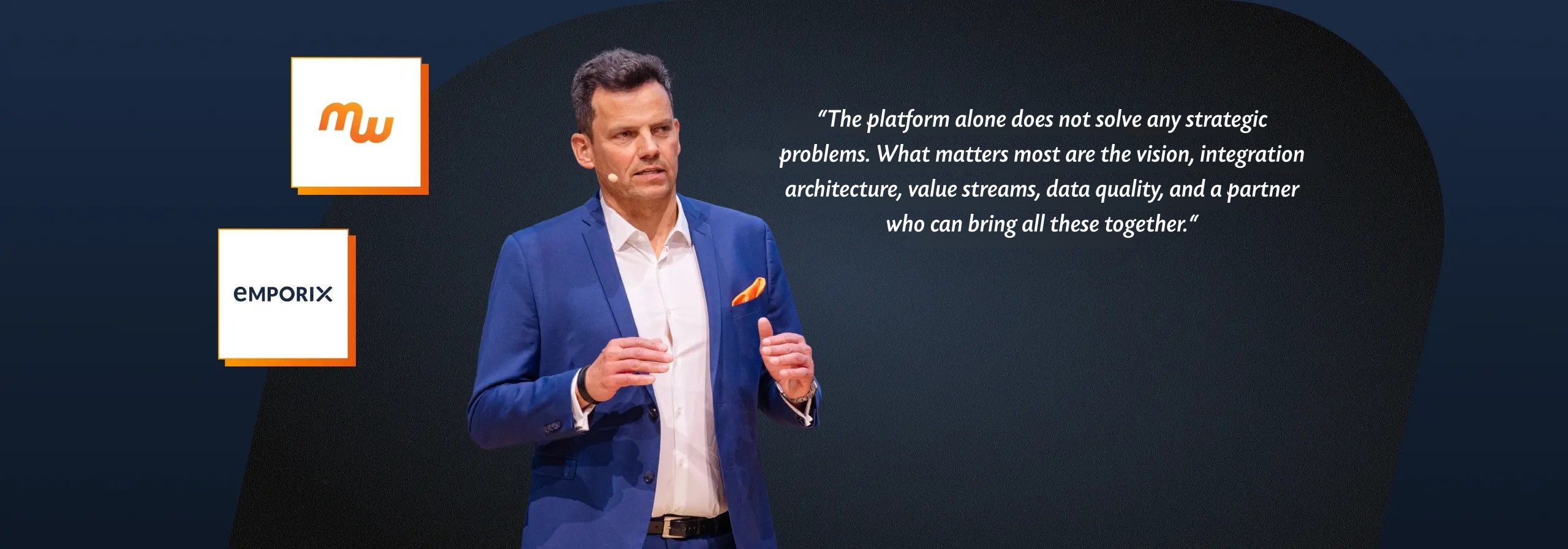
Why B2B companies need more from Emporix than just a traditional implementation partner
A managing director’s perspective on Emporix, B2B portals, SAP integration and Agentic Commerce – and on the skills that really matter when choosing a service provider today.
Key Takeaways
- Emporix should not be viewed merely as a shop system. For many B2B companies, the greater leverage lies in a portal acting as a single point of service across the entire product lifecycle.
- Value streams link commerce, service, support, after-sales, ERP, PIM, CRM, IoT data and AI agents to form manageable process chains.
- AI agents are particularly effective when they are integrated in a controlled manner into end-to-end processes.
- SAP’s vision of the Autonomous Enterprise confirms the market trend. However, this does not automatically mean that every SAP-affiliated company should leave its commerce and portal architecture unchanged.
- MACH and Composable Commerce remain important, but are more of a technical foundation. Decision-makers want to know whether a platform is AI-native, process-capable, cost-effective and compatible with SAP.
- Emporix is not the right fit for every company. The platform is particularly relevant for complex B2B scenarios, portal strategies, after-sales, spare parts business and clear automation objectives.

Hendrik van Laaten
Head of Medienwerft
When I talk to B2B companies about Emporix these days, the discussion is rarely just about a new online shop. The real question is usually: How do we create a digital platform that supports customers, retailers, service partners and internal teams throughout the entire product lifecycle?
This also shifts the criteria for choosing a service provider. A traditional implementation partner who simply sets up the catalogue, shopping basket and checkout is no longer sufficient for many projects. The key factor is whether a partner can take a holistic view of portal strategy, business processes, SAP integration, data models, AI agents and operations.
I am deliberately writing this post in my capacity as Managing Director of Medienwerft. It is not a neutral market study, but rather an assessment based on our project and consultancy experience. That is precisely why this is not about recommending Emporix across the board. It is about when Emporix makes sense, what skills a project requires, and why the question of platform choice today extends far beyond e-commerce.
What does it mean to integrate Emporix?
In my view, integrating Emporix does not automatically mean replacing one existing shop system with another. In many projects, an operational layer emerges that links commerce, the portal and business processes.
In traditional e-commerce, the focus is often on the product, price, shopping basket and checkout. In complex B2B scenarios, this is not enough. A manufacturer of durable goods requires spare parts processes, maintenance information, documents, warranty and guarantee logic, service cases, legal documentation, dealer processes, role and authorisation models, and often also IoT data from machines or devices.
This is precisely where Emporix comes into its own: not just as an e-commerce platform, but as a potential core component of a portal and process architecture. The benefits arise where commerce functions, business logic, ERP data, service processes and automation converge.
From a B2B shop to a single point of service
Many companies start by asking whether they need a new shop. However, it often becomes apparent during the project that the actual requirements are more extensive. Business customers do not just want to place orders. They want to check prices, find spare parts, create service requests, view delivery dates, access documents, manage equipment, view contracts and interact with support or sales.
A modern B2B portal thus becomes a single point of service. It consolidates touchpoints, data and processes across the entire lifecycle. For companies, this delivers more than just a better customer experience. It means fewer manual enquiries, fewer media breaks, faster response times and new digital services not found in a traditional shop.
This approach can be economically crucial, particularly for complex products with a long lifecycle. By making all relevant information and actions available via the portal, companies maintain contact with customers after the purchase, strengthen the brand when service is required, and lay the foundations for a digital spare parts and service business.
The term ‘value stream’ describes an end-to-end business process that generates value for both the customer and the company. In e-commerce, this might be an order. In a portal, however, it could also be a spare parts process, a complaint, a maintenance request, a service order or a digital verification process.
The difference compared to traditional shop systems lies in the perspective. Traditional platforms provide functions: product catalogue, shopping basket, checkout, customer account. Emporix thinks more in terms of process chains. Value streams can link systems, data, roles, rules and decisions. This is precisely what is relevant for B2B, because processes rarely follow a linear path.
A spare part may depend on the machine, contract, location, maintenance status, customer role and availability. A service case may involve legal requirements, documentation obligations and approvals. Such scenarios require more than just a front-end. They require process architecture.
MACH – that is, microservices, API-first, cloud-native and headless – remains an important technical foundation. Without open interfaces, modular services and clean data flows, Autonomous Commerce will be difficult to implement.
For decision-makers, however, MACH is rarely the main selling point these days. They want to know whether a platform speeds up processes, reduces costs, eases the workload on teams, enables new services and integrates with the existing SAP landscape. MACH forms the basis for this, but it is not the actual management pitch.
Agentic Commerce and Autonomous Commerce: the distinction
Agentic Commerce and Autonomous Commerce are often mentioned in the same breath. However, for the purposes of strategic classification, they should be clearly distinguished.
Agentic Commerce
Agentic Commerce refers to the use of AI agents in specific commerce, portal and service processes. These agents can analyse data, recognise patterns, prepare decisions, trigger follow-up processes or handle routine cases. Depending on the level of risk, humans remain in the lead or in the loop.
Autonomous Commerce
Autonomous Commerce continues to evolve. The focus here is not on the individual agent, but on the increasingly self-managing process chain. Value streams, orchestration, data models, rules, governance and AI all work together.
Agentic Commerce therefore refers more to the actors involved, whilst Autonomous Commerce describes the ultimate goal. This distinction is important for B2B processes. It is not enough simply to integrate a chatbot or individual AI functions into a shop. The key factor is whether processes can be automated in a controlled manner: with clear data sources, measurable rules, defined exceptions, ‘human-in-the-lead’ for objectives and accountability, and ‘human-in-the-loop’ for approvals, risks and legally relevant procedures.
For example, an AI agent can pre-qualify an incoming service case based on product, contract and service data, identify missing information and categorise the case. If it is a potential warranty claim, the agent prepares the decision and forwards it to a responsible member of staff for approval. Standard cases can then proceed automatically to the next stage of the process, whilst sensitive or unclear cases remain with the ‘human-in-the-loop’.
Putting Autonomous Commerce into the Right Context within SAP
The fact that SAP has now set out a similar vision for enterprise software in the form of the Autonomous Enterprise is, in my view, an important signal. The market is moving towards AI-powered, process-oriented and more self-managing enterprise systems. For customers closely associated with SAP, this confirms the strategic direction.
However, this does not automatically mean that organisations using SAP no longer need a specialised commerce and portal architecture. In many B2B companies, SAP remains the backbone for managing customers, prices, terms and conditions, availability, orders, invoices and core processes. The question, however, is which level connects customers, retailers, service partners and digital value streams in day-to-day business.
This is precisely where Emporix can play a valuable role: as an AI-native, MACH-based commerce and portal layer that does not replace SAP, but integrates it into a modern process architecture. Architectural assessment is key here. Not every system that currently supplements autonomous functions is fundamentally designed for open, modular and AI-supported process control. Emporix positions orchestration, value streams and composable commerce as the central building blocks of its platform. The agents are integrated into value streams via an AI layer known as ‘Agentic Commerce Intelligence’.
The decision is therefore not between SAP and Emporix. In many projects, the question is: How do we integrate SAP as the leading system for core processes with an AI-native portal and commerce layer that makes customer processes faster, more flexible and more cost-effective?
Which companies should consider Emporix?
Emporix is particularly well suited to companies whose digital business does not consist of a simple, off-the-shelf online shop. Typical scenarios include complex B2B processes, long-lasting products, after-sales services, spare parts, customised prices and contracts, international roll-outs, SAP integration and the desire for a modern platform architecture.
Emporix is not always the best solution. If a company is committed to an existing manufacturer’s ecosystem, is pursuing a clear platform strategy with another provider, or simply requires a very basic online shop, another solution may be more appropriate. Good consultancy begins precisely at this point: with the question of which target scenario is the right fit from a commercial, technical and organisational perspective.
How to recognise a suitable Emporix partner

Understanding portals and lifecycle
Roles, permissions, documents, tickets, service cases, spare parts, product data, contracts and legal requirements – a partner must understand how customers, dealers, technicians, service partners and internal teams work within the portal.

Process architecture instead of a list of functions
More important than a long list of features is the question of which value streams should be digitised or automated first: the spare parts process, dealer onboarding, maintenance cases, complaints, the quotation process or the documentation process.

Experience with ERP and SAP integration
With SAP, it’s all about process accountability and operational stability. That’s why a partner needs to know how to integrate prices, availability, customer bases, orders, invoices, authorisations and error handling processes seamlessly.
Expertise in AI agents and orchestration
AI-native commerce projects require data flows, rules, decision-making logic, automation chains, agent architectures, transparency and governance. A pragmatic approach: a controlled value stream with measurable benefits, rather than a grand promise of autonomy without clear accountability.
A realistic view of cost-effectiveness
Cost-saving opportunities do not arise from buzzwords, but from less manual work, fewer errors, lower operating costs, faster process cycles and new digital services. A reputable partner must assess these levers at an early stage, in collaboration with the business department and IT.
An overview of the various integration paths for Emporix
Emporix does not always have to be implemented as a ‘big bang’ project. Depending on the initial situation, various approaches are possible:
Emporix as a new operational layer for commerce and the portal: suitable when commerce, the portal and service processes are to be comprehensively modernised.
Gradual modernisation of individual value streams: advisable when a clearly defined process is to deliver benefits first, for example, spare parts ordering or a service case.
Platform migration whilst retaining the existing storefront: possible where the front-end is to remain in place initially and the back-end, in particular, is to be modernised.
Portal-first approach with commerce functionality: relevant where customer service, service, documents, contracts, IoT data and support are more important than the checkout process alone.
Why we have tailored our service portfolio specifically to this
We do not position Medienwerft as just any implementation partner for every e-commerce project. Our focus lies where Emporix comes into its own with complex B2B processes, portal strategies, SAP-integrated architectures and AI-driven automation.
As part of the FIS Group, we combine commerce development, SAP expertise, requirements engineering, UX, project management, operations and an understanding of business processes. This combination is crucial for Emporix projects because success rarely depends on a single function. It arises from the interplay between the platform, integration, processes, data, service and acceptance within the organisation.
Our awards as Emporix Best Sales Partner and Partner of the Year 2026 are a testament to our close partnership. However, they do not replace the technical assessment required for the project. The decisive factor remains whether the vision, architecture, cost-effectiveness and organisation are all aligned.


Case study HABA FAMILYGROUP:
Lessons to be learnt from the platform switch
One example of a streamlined migration to Emporix is HABA. There, we replaced the existing commerce system with Emporix without having to completely rebuild the existing storefront. This case study demonstrates that a platform change does not automatically have to involve a major overhaul.
The key point is not merely the 50 per cent reduction in TCO. What is more crucial is the approach: continuing to utilise existing assets, tackling the biggest cost driver in the backend, and implementing the migration within a manageable scope. This figure cannot be applied across the board to new projects – it is a specific case study figure and depends on the initial situation, licensing model, operations, migration and target architecture.
LEARN MOREConclusion
The real question about platforms goes beyond e-commerce
Emporix should not be assessed solely through the lens of traditional e-commerce projects. For many B2B companies, the greatest potential lies in an AI-native portal that brings together commerce, service, support, after-sales, ERP integration and process automation.
The crucial question is therefore not simply: Which system can run a shop? The better question is: Which platform helps the company improve processes today whilst remaining future-proof for the AI era?
If complex products, long life cycles, spare parts business, service processes, legal requirements or IoT data play a role, it is worth taking a closer look at Emporix. But even then, the platform alone will not solve any strategic problems. What matters most are the vision, integration architecture, value streams, data quality and a partner who can bring all these elements together.
Talk to us about your current situation. Together, we’ll assess which value streams are relevant to your business, whether Emporix fits your target architecture and which first step makes the most business sense.
KEY QUESTIONS AND ANSWERS
ON THE EMPORIX INTEGRATION
SAP remains the leading system in many B2B companies for managing customers, prices, terms and conditions, availability, orders and invoices. Emporix can act as an AI-native commerce and portal layer that harnesses SAP data and SAP processes for digital customer, retailer and service processes.
Yes, Emporix can be integrated into existing SAP systems such as S/4HANA.
As a certified SAP Gold Partner, Medienwerft has the necessary expertise to implement end-to-end processes from commerce right through to ERP.
The costs depend heavily on the scope of the project. Factors such as the number of integrations, the complexity of the business rules and bespoke customisations all influence the budget.
Following an analysis phase, Medienwerft provides a transparent quotation with clearly defined services.
A standard project takes between three and nine months to go live. The exact duration depends on your requirements.
Medienwerft will provide you with a realistic timetable featuring defined milestones, so that you know what to expect right from the start.
Medienwerft is a leading Emporix partner, Emporix Partner of the Year 2026 and a Thermosphere partner. As a committed supporter from the very beginning, we have the most successfully implemented Emporix client references within the partner network and develop forward-looking, AI-native e-commerce platforms and portals for renowned B2B and B2C companies. We are part of the internationally active FIS Group and combine in-depth commerce expertise with SAP ERP integration and process expertise.
Drawing on this experience, we also develop solutions and products for Emporix itself, including a Backend-for-Frontend and Frontend as a Service, and offer hosting services. As a leading Enablement Partner, we support internal and external teams with their first Emporix projects through on-the-job training and lay the foundations for scalable, automated and AI-native commerce processes.
Yes, Medienwerft offers comprehensive expert support for the day-to-day operation of your Emporix platform.
From troubleshooting and updates to further development – you have a competent partner at your side who understands your solution and optimises it.
Emporix is aimed at enterprise and mid-market companies with complex B2B requirements.
Medienwerft’s Lean Commerce approach also makes the platform attractive to small and medium-sized enterprises by reducing costs and delivering rapid results.